

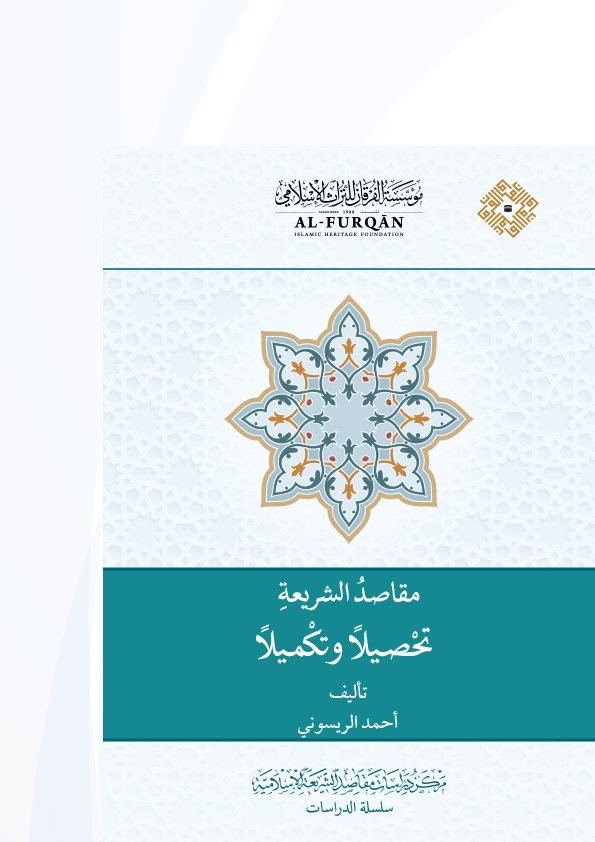
Summary
Maqāṣid al-Sharīʿah Taḥṣīlan wa Takmīlan an important book — a precious gem and a distinguished scholarly reference that has long been awaited, a beacon lighting the paths of independent legal reasoning (ijtihād) for scholars and researchers, and a renewer of hope in understanding the illustrious Islamic law. It answers the enduring question: where is the well-grounded, meticulously verified reference on the objectives of Sharīʿah — one that does not merely present information, but illuminates the paths of acquiring it and renews the landmarks of understanding?
This reference work is distinguished by firmly established scholarly qualities that combine methodological precision with depth of vision, painting a fully integrated picture of the objectives of Sharīʿah — not as passing ideas or memorized concepts, but as a living structure in which methodical acquisition intertwines with intellectual completion.
The book treats the maqāṣid with precision: it defines them, traces them back to their roots in the texts of the Qur'an and Sunnah, then follows their historical development, highlighting their status as the spirit and beating heart of Sharīʿah. The maqāṣid are not merely a theoretical idea or an intellectual luxury, but rather the practical guide that preserves for Sharīʿah both its flexibility and its firmness together, enabling the jurist, the researcher, and the decision-maker to rationalize understanding and ijtihād in light of ever-renewing challenges. Nor is this presentation directed at one group to the exclusion of another; the author wrote the book with the eye of a specialized researcher, the heart of a teacher addressing a university student, and the awareness of an intellectual engaging this thorny subject in clear, well-organized language — building in this a bridge of knowledge linking different levels of students.
As for the book's methodological structure, it maintains a graduated system: it begins by establishing the foundational concepts, laying the groundwork for a contemporary reading of the relationship between taʿabbud (ritual submission) and taʿlīl (rational causation), and analyzing the criterion of benefits and harms (maṣāliḥ and mafāsid) and their ranks; then it delves into explaining the theory of the five necessities (al-ḍarūriyyāt al-khams) and their pivotal concept. After establishing these foundations, the author expands to discuss the system of benefits (maṣāliḥ), deepening the examination of doctrinal and ethical objectives; he also gives due space to the authoritative and binding force of the maqāṣid in ijtihād, linking theory and application in a masterful way that gives the work a depth that does not overlook reality.
What truly distinguishes this work is its intelligent linking of the maqāṣid heritage with the challenges of the age. The book stands upon the efforts of the scholars of the past, quoting them directly, then meets this with a contemporary critical sense that captures modern problems and seeks to renew knowledge rather than merely reproduce it. From here the book's added value becomes clear, as it raises profound issues — such as distinguishing between taʿlīl and taʿabbud, detailing the ranks of material and spiritual benefits, and discussing problematic questions such as the presence of the maqāṣid in the jurisprudence of wealth (fiqh al-māl), or the status of ethics and higher meanings in establishing the values of Sharīʿah and supporting shared human ground.
Reviews
There are no reviews yet.