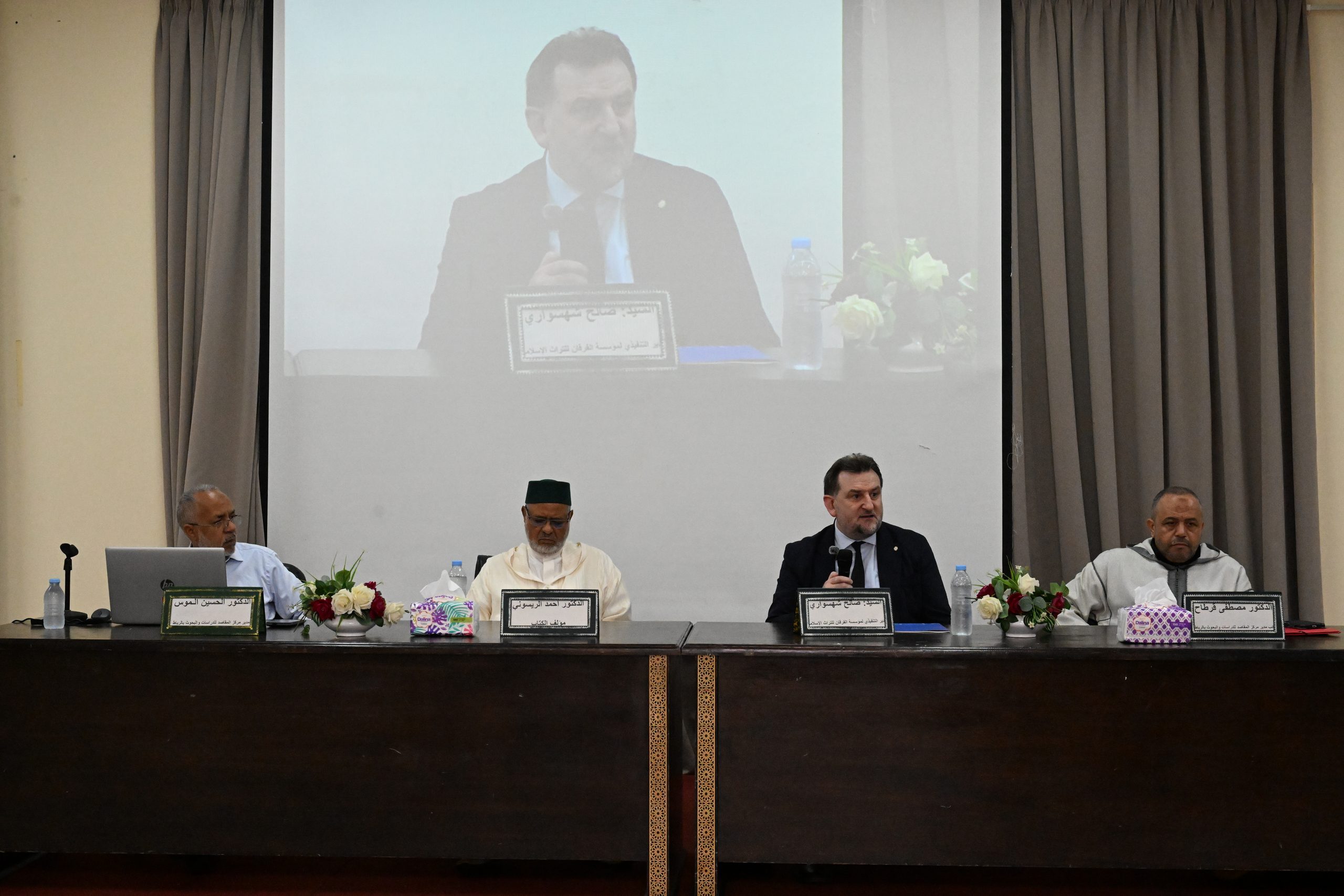
Al-Furqan Islamic Heritage Foundation and the Al-Maqasid Centre for Studies and Research in Rabat organised an academic symposium on the book “Maqāṣid al-Sharīʿa: Taḥṣīlan wa-Takmīlan” (The Higher Objectives of the Shari’a: Consolidation and Completion) by the Dr Ahmed Raissouni, his latest publication in the field of maqāṣid studies. The symposium was held on 20 October 2026 at the Training Centre in Rabat.
Dr El Houcine El Mousse, Director of the Al-Maqasid Centre for Studies and Research in Rabat, chaired the session, which opened with a recitation of verses from the Holy Qur’an by the reciter Sheikh Abderrahmane Chettour.
Mr Sali Shahsavari, Managing Director of Al-Furqan Islamic Heritage Foundation, then spoke about the book’s importance. He praised its author, who has always brought something new, and said the book being celebrated that day completes a maqasid trilogy: The Dictionary of Maqasid Terminology, The Maxims of the Higher Objectives, and now The Higher Objectives of the Shari’a: Consolidation and Completion. He explained that the book had been a project of the Foundation for some years, and that the Foundation had urged the learned scholar Dr Ahmed Raissouni to write it. The book, he said, meets a need to present questions of the higher objectives in an accessible way that puts them within researchers’ reach. He described it as unique in its field and in its composition.
The author, Dr Ahmed Raissouni, then spoke about the book’s importance and went on to explain its sections and chapters. He highlighted the consolidation side of the work, touched on the completion side, and urged students to do further research on completion and renewal.
Dr Naji Lamine, Professor of Higher Education at Dar al-Hadith al-Hassania, followed with a contribution on the book’s methodological and historical framework.
Dr Mustapha Kartah, Deputy Director of the Al-Maqasid Centre for Studies and Research in Rabat. then presented his reading of the book. He argued that it contains two kinds of completion, which together form its core:
• Theoretical completion: adding topics that al-Shatibi did not cover and developing them theoretically, such as the preservation of non-material interests.
• Practical, applied completion: turning the higher objectives from a body of knowledge into practice. According to the author, this completion is an ongoing process that must not stop, and it requires renewed collective juristic reasoning in every university, centre and institution.
Dr Kartah said that Dr Raissouni had shown real originality in his method of consolidation and completion: he traces the historical and scholarly development of the higher objectives, then sets out the maxims, universal principles and examples. He also praised the author’s style for its clarity and ease of expression, free of needless complexity.